



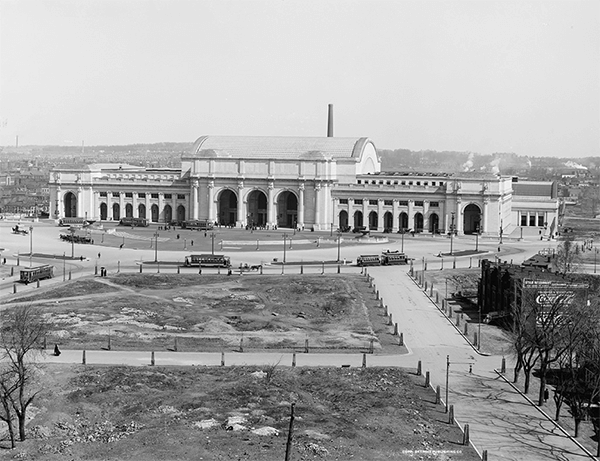
Washington Union Station is one of the country’s first great union railroad terminals. Designed by renowned architect, Daniel Burnham, the station opened on October 27, 1907 and was completed in April 1908.
During its heyday in the early 1940’s, Union Station was a thriving transportation hub serving up to 42,000 passengers daily. After 1945, conditions deteriorated quickly. The demand on transportation during World War II wore greatly on the station, and repairs were often done inexpensively, diminishing the station’s elegance. Public trends shifted from rail to cars and planes for long-distance travel, which further diminished rail passenger revenues, station activity and the feeling of excitement that once percolated through the building.
In the late 1950s, the Station’s owners began searching for an alternative use. In 1964, DC designated the building an historic landmark and in 1969 it was listed in the National Register of Historic Places; Columbus Plaza, located in the front of the station, was listed in 1980. During the mid-1960s, the federal government took over the building for use as a new National Visitor Center. However, a lack of funding for the conversion, poor design and changing tastes made it a failure soon after it opened in 1976. Union Station’s low point came in 1981 when a driving rain sent pieces of the ceiling, already damaged by a leaky roof, crashing down into the main waiting room. Most of the building had to be closed, which disrupted travel for the growing number of Amtrak passengers.
In 1981, Congress passed the Union Station Redevelopment Act. It stated that, “the Secretary of Transportation shall provide for the rehabilitation and redevelopment of the Union Station complex primarily as a multiple-use transportation terminal serving the Nation’s Capital, and secondarily as a commercial complex, in accordance with the following goals:
Preservation of the exterior façade and other historically and architecturally significant features of the Union Station building;
Restoration and operation of a portion of the historic Union Station building as a rail passenger station, together with hold facilities for charter, transit, and intercity buses in the Union Station complex;
Commercial development of the Union Station complex that will, to the extent possible, financially support the continued operation and maintenance of such complex; and
Withdrawal by the Federal Government from any active role in the operation and management of the Union Station complex as soon as practical and at the least possible Federal expense consistent with goals set forth in subsections (a) through (c) of this section.
In 1983, the United States Secretary of Transportation established a public/private partnership that funded the $160 million-dollar restoration of the station. The completion of this project in 1988 saw the station reopened with 3 levels of retail space.
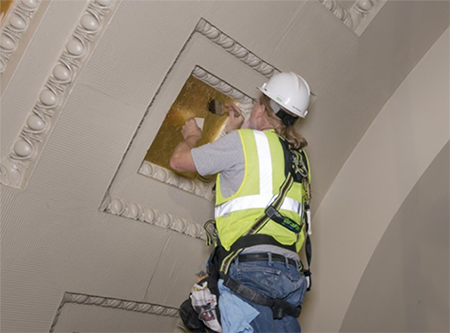
In August 2011, a 5.8 magnitude earthquake shook the DC metropolitan area, effecting Union Station. The most notable damage was to the historic plaster ceilings in the Main Hall and Retail Concourse. In order to inspect and repair the monumental coffered ceiling, a rolling scaffolding system was designed to allow for the public to continue to safely pass through the station while work progresses above.
In the Main Hall, the ceiling is comprised of five bays. Each bay received plaster repairs, fresh paint, and new, higher quality gold leaf. Above the ceiling, a new steel support system was installed for the plaster, along with improvements made to the ventilation system and worker maintenance access. Each bay took approximately six months to complete, and in the spring of 2016, all five bays were completed.
Aiding the project financing for the Main Hall restorations, was a grant awarded to the National Trust for Historic Preservation, and gifted to USRC from the American Express Foundation. The $350,000 grant has assisted in funding the re-gilding of the Main Hall ceiling in a higher quality, 23 karat, 18 gram weight gold, which increased the life expectancy to 75-100 years.
In 2008, Union Station developers, Union Station Investco (USI), proposed new retail plans that would alter the historic Main Hall. As a historic building owned by the federal government and listed in the National Register of Historic Places in 1969, there is a federal requirement by the National Historic Preservation Act of 1966 that a Section 106 consultation must be carried out prior to any alterations. Originally, the marketing plans proposed two oblong openings on each side in the Main Hall floor just north of where the Center Cafe was positioned. The openings, equipped with up and down escalators, would allow patrons to access new retail in the lower level area that previously housed the movie theaters (which closed in 2009). The proposed plans presented in 2010, and revised in 2011, were determined to have an adverse effect by the Federal Railroad Administration (FRA) in June of 2012. In September of 2012, the proposed plans were modified to reflect feedback from consulting parties and to reduce the noted adverse effects.
In spring, 2016, after several years of discussion and plans, the FRA and State Historic Preservation Office (SHPO) concurred with a Memorandum of Agreement (MOA) resulting in the elimination of the Center Cafe and fountains in the Main Hall. The Center Cafe closed on March 1, 2016 and demolition on the restaurant space and fountains followed, with the Main Hall restoration completed in May 2016. To assist passengers, new directory boards displaying rail arrival and departure information were installed in the transoms above the doorways leading to the train concourse, similar to their historic placement. New digital directories have been placed at entry points throughout the station, and digital signage was installed in the Main Hall and the train concourse.
